Avant Foundation impact
We define and measure against our objectives and goals so our impact can be tracked over the long term.

Our objectives and goals have been designed to create lasting, positive change in the Australian medical landscape so that we can meet our purpose to:
- support research that will improve quality, safety, sustainability and professionalism in the practice of medicine
- fund programs working with medical practitioners to improve patient care and health outcomes
- help doctors overcome their experience of disadvantage in the pursuit of their medical or healthcare studies.
We ask all applicants to demonstrate how their research impact can be measured and we prioritise grants that align with our impact objectives and goals. Please read this section alongside the assessment criteria for each grant round, as they will both help you to determine whether your project aligns to Avant Foundation’s strategy.
How your research aligns with our impact objectives and goals
Please read this carefully as we have recently changed our approach to impact measurement.
When completing a full application, applicants should first select from our impact objectives and goals and then provide your own metrics to articulate your expected measurable outcomes.
For example, you might choose the impact objective of ‘Quality’ and the associated impact goal of ‘Quality of medical practice’. You should then design and provide the metrics you believe are most appropriate for the project, based on the guidelines below. If you are successful in being awarded an Avant Foundation grant, then we will discuss the metrics in more detail before you begin.
When your research is complete, the actual outcomes are recorded against the metrics you committed to at the outset.
Guidelines on designing impact metrics
Measuring the impact of health and medical research is not easy, for a multitude of reasons: not everything is measurable, many grant funding acquittal periods are far too short to expect real world impact on complex problems, and often the cost of quality longitudinal tracking is prohibitive when that investment would be better directed to solving the actual problem; to name just a few. However, whilst new knowledge or disproved hypotheses are obviously valuable, limiting success measurement to academic bibliometrics alone misses the whole point of the endeavour.
As a Foundation, we’ve also found that being too prescriptive about impact metrics on a granular level is counterproductive when we have a broad interest in system improvement and we are not the experts leading the research. So, in 2026 we have shifted to a ‘researcher designed’ approach to metrics at the full application stage, complemented by a collaborative process for confirming and reviewing them as the project commences and progresses.
In addition, we have introduced an annual program of informal alumni communications with historical grant recipients post-acquittal, so we can keep abreast of how your career and research progress over the long term.
When designing your metrics you might find this table useful, however it is neither exhaustive nor prescriptive. We are interested in your ambitions. What targets can you set now, but also what medium- or long-term influence could your project have, even if you can’t put a number on it now?
| Short-term Outputs | Medium-term Outcomes | Long-term Impacts |
|
|
|
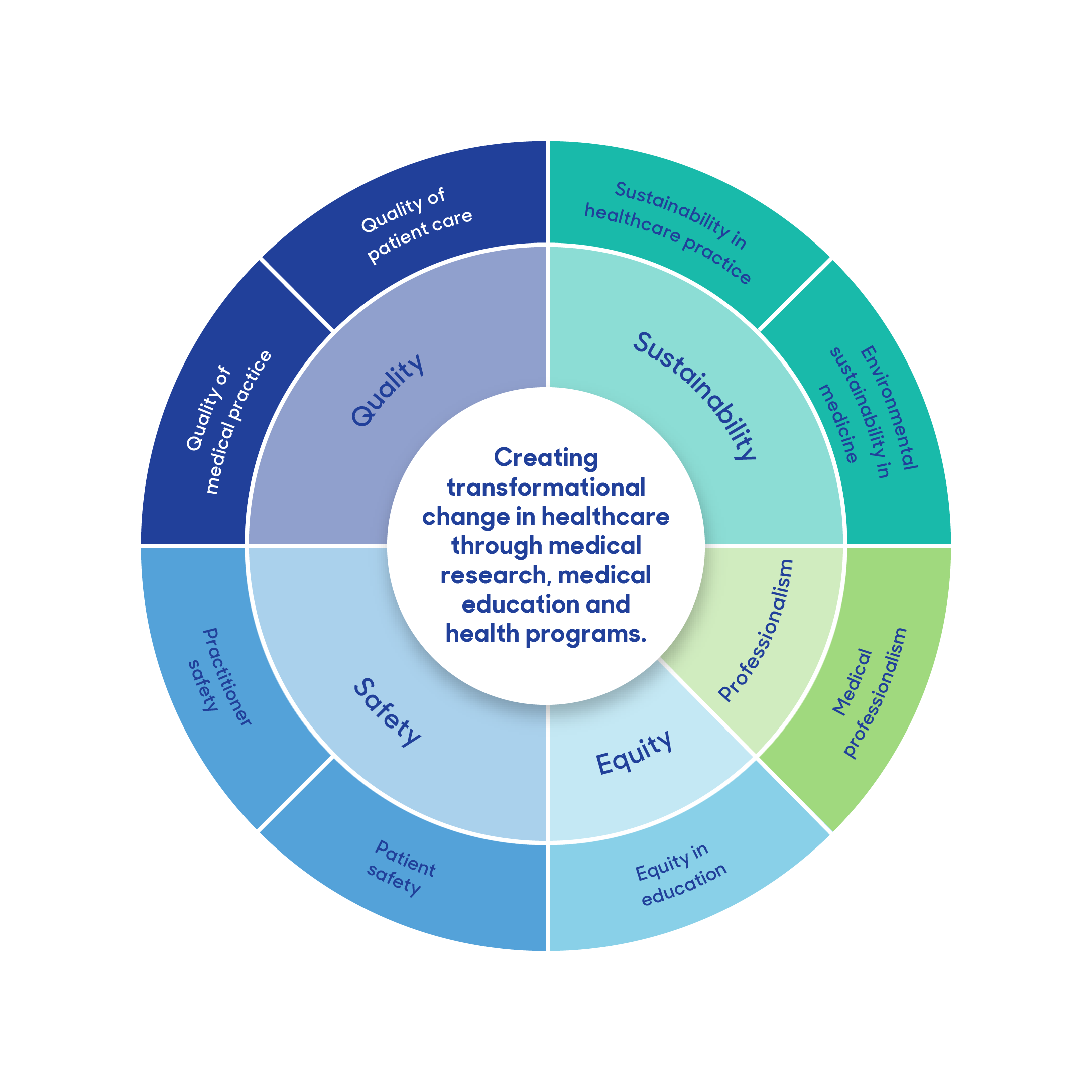
Our impact objectives and goals
Quality
| Goal |
| Quality of patient care |
| Quality of medical practice |
Safety
| Goal |
| Practitioner safety |
| Patient safety |
Equity
| Goal |
| Equity in education |
Professionalism
| Goal |
| Medical professionalism |
Sustainability
| Goal |
| Environmental sustainability in medicine |
| Sustainability in healthcare practice |
Impact framework